
As VEED’s creator program grew, managing campaigns across spreadsheets, email, and DIY automations became increasingly time-consuming. VEED’s Influencer Marketing Manager, Abbie, needed a better way to manage creators, track performance, and understand what was driving results.
Passionfroot brought VEED’s creator operations into one place, while Zest helped speed up sourcing, briefing, and analysis. With less manual work and clearer insights, Abbie can experiment confidently, activate more creators, and drive increased sign-ups and visibility in AI search.




The challenge: Scaling creator marketing without adding more manual work
When Abbie Lane joined VEED as influencer marketing manager, the company was still testing the waters with creator partnerships. Her focus was to prove the channel’s ROI and build a program that could scale. She now oversees both influencer and affiliate marketing within VEED’s growth team.
At the start, Abbie was tracking campaigns in a large Google Sheet, managing creator conversations through Gmail, and experimenting with AI automations. But, operations were clunky. For example, those automations often created more maintenance than they did simplification.
VEED needed a single place to manage creator relationships, payments, and performance. Abbie also wanted a clearer view of how the program was progressing, with real-time insights and reporting, so she could experiment and confidently double down on what was working best month over month.
The solution: Bringing creator operations under one roof
VEED’s first campaign on Passionfroot was a LinkedIn test, working with a handful of creators on an evergreen awareness campaign. Abbie knew LinkedIn was an important channel to reach VEED’s target audience, but historically, recruiting creators there had been tough.
On Passionfroot, she could both discover and outreach creators, helping to fill VEED’s campaign budget and get creator content live quick, without the usual back and forth.
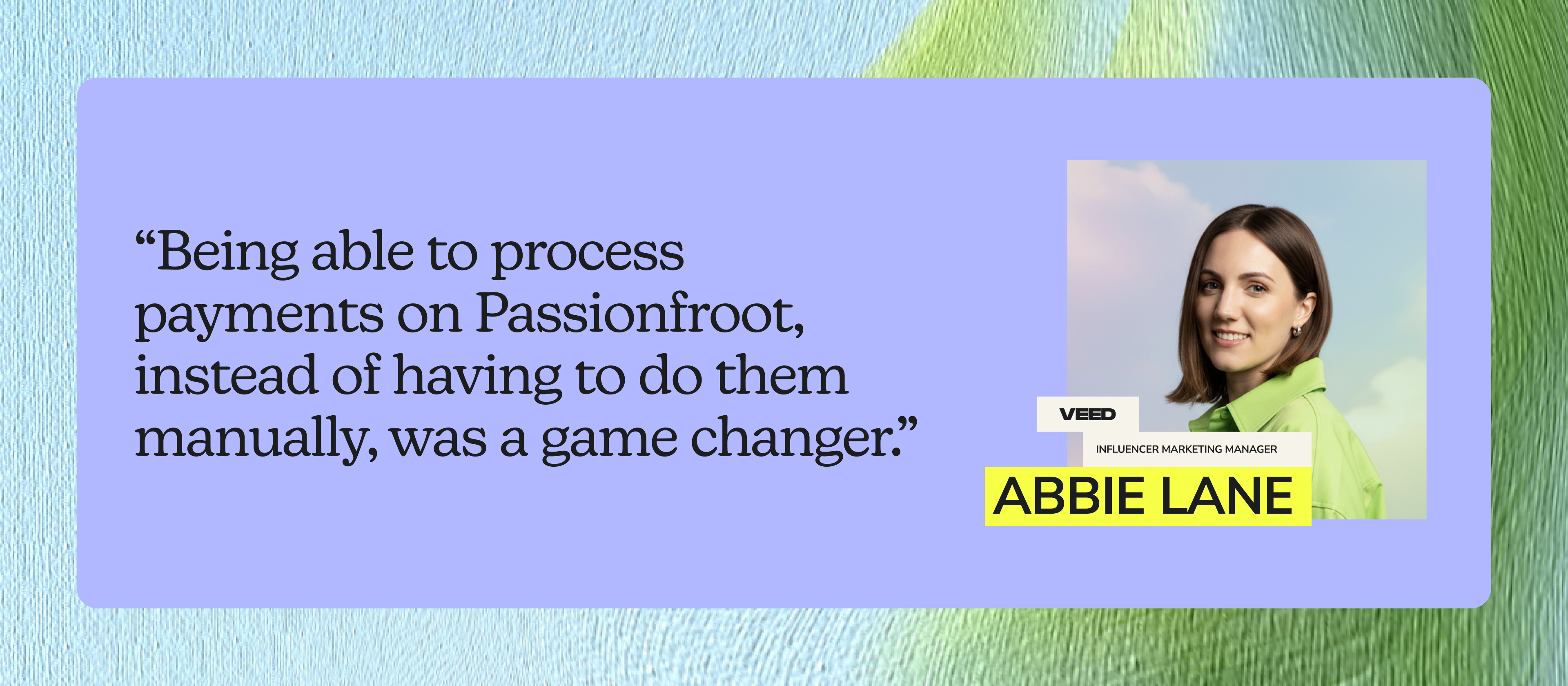
That first LinkedIn test drove reach and saved Abbie time managing operations (think: creator communications, campaign tracking, and analyzing performance data). Importantly, payments became easier, too.
Since joining Passionfroot, VEED has increased its average monthly creator activations by 17%.
As Abbie fell into a consistent workflow on the platform, she also began using Zest, Passionfroot’s AI agent, more regularly. Take creator briefs, for example. Today, once she has a brief that works, she can simply give Zest a few details about an upcoming product launch and build a reliable new brief in seconds.
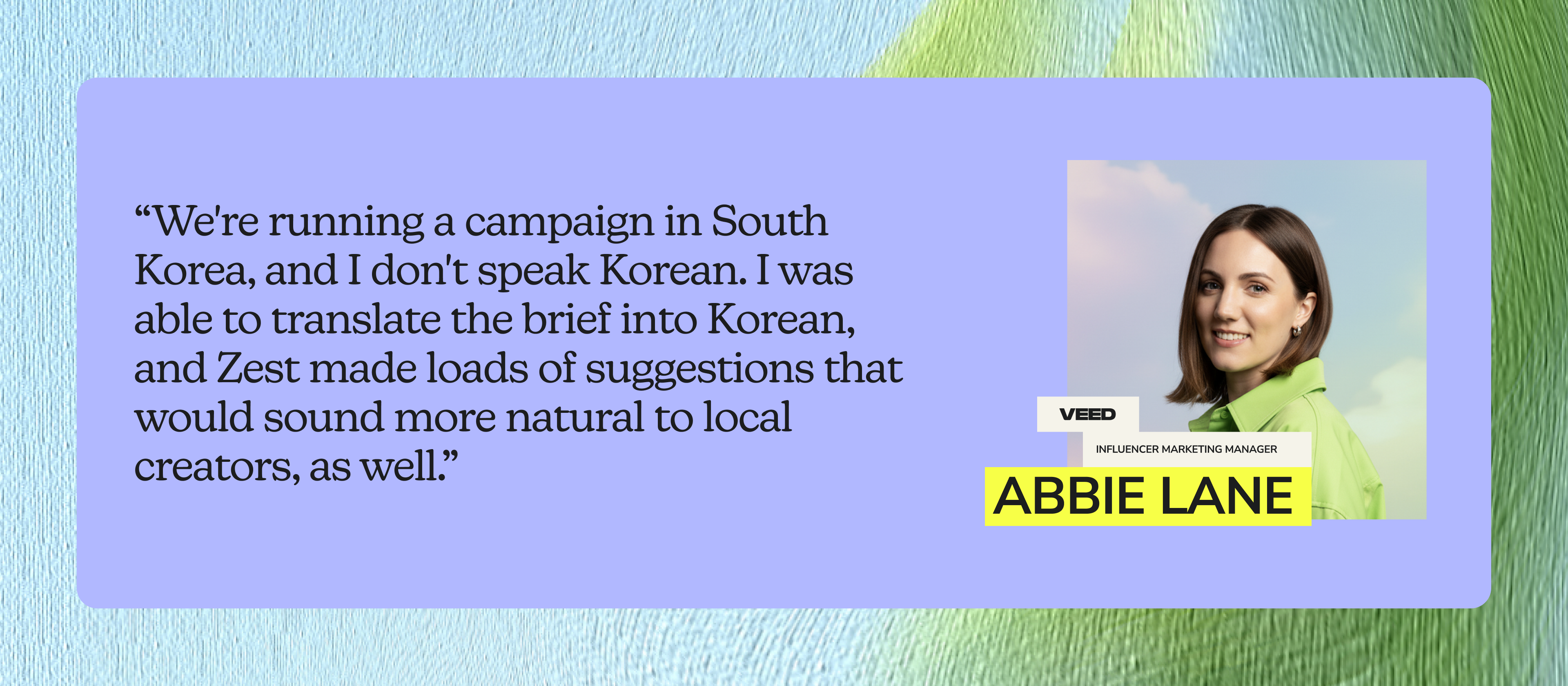
Zest also helps her find lookalikes of top-performing creators, translate briefs for international campaigns, and review top-line campaign results.
The results: More sign-ups, even when views went down
VEED measures the impact of creator marketing by tracking sign-ups and customer acquisition cost. Notably, that means looking beyond links and promo codes, which Abbie estimates capture less than 5% of creator marketing’s impact as a channel. Instead, they use a combination of self-reported attribution and lift analysis.
VEED also consistently iterates on content learnings to improve future campaigns. For October, Abbie identified the best-performing content from September, brought back some of those creators, and tested lookalikes with similar audiences. She also doubled down on brand messaging rooted in ‘time savings,’ which resonated with entrepreneurs, small-business owners, and even parenting communities.
Thanks to her iterative and experimental approach, that October campaign saw a meaningful increase in creator-attributed sign-ups to VEED. Her takeaway: reaching the right audience with highly-resonant messaging can have a greater impact than maximizing reach alone.
Thanks to Zest, the team can continuously analyze the creative and results side by side, allowing Abbie to be data-driven and confident in her approach to upcoming campaigns. No more guesswork or starting from scratch.
Using creators to tell a bigger story about VEED
VEED’s creator program also plays a key role in repositioning the company. Since 2018, most people have known VEED as a video editor. The product has expanded since, evolving alongside the technology behind it. Today, users can start with just an idea, describe the video they want, and VEED generates, cuts, reframes, subtitles, and brands it until it looks like theirs.
VEED began shifting that perception by introducing itself as an AI video creation platform, and creators made the shift visible. They showed their audiences what the product can now do, starting with a prompt instead of a timeline
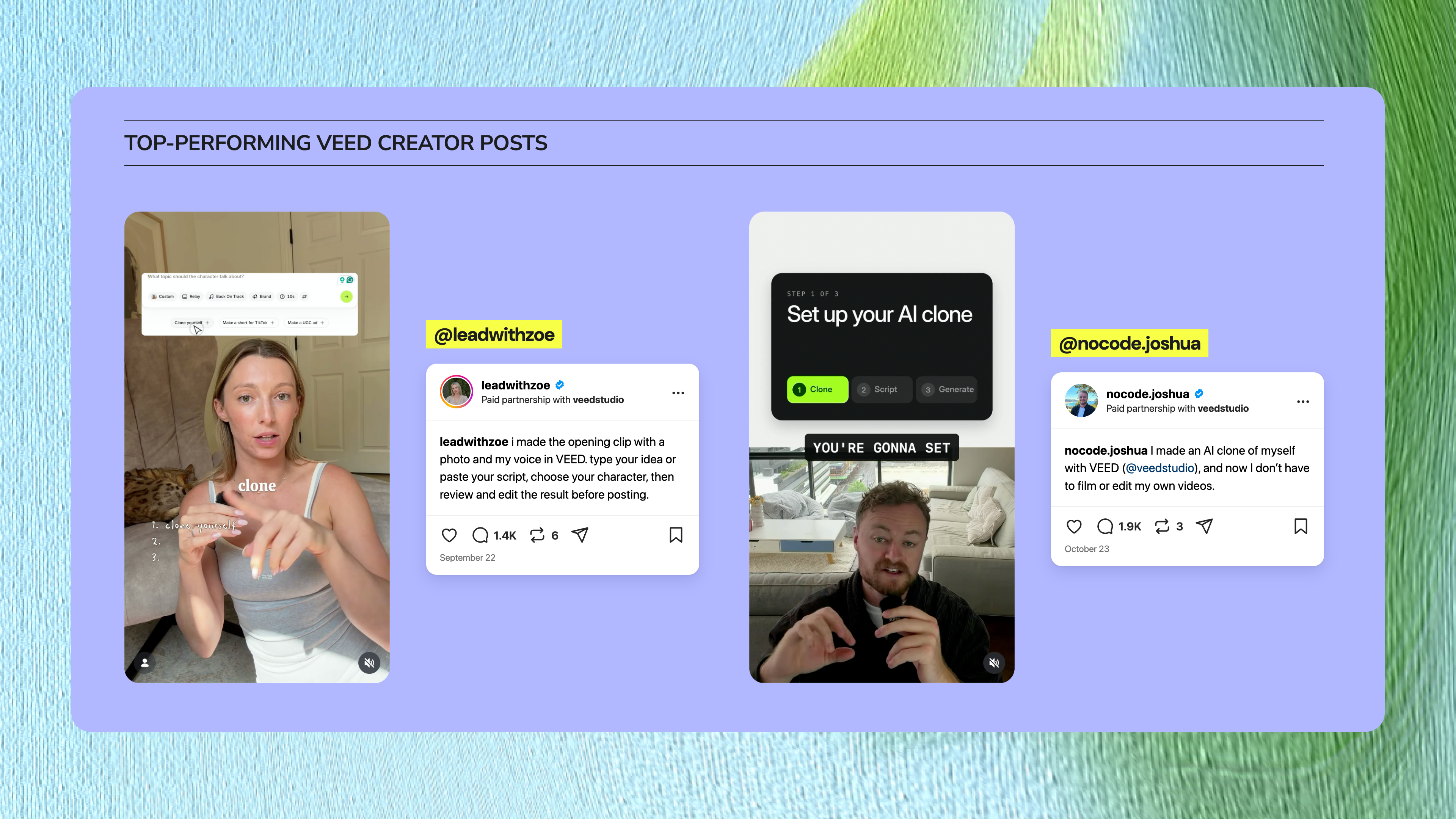
Examples of recent top-performing posts include leadwithzoe and nocode.joshua, whose content brought to life VEED’s AI clone feature, which allows creators to make a clone from a single selfie and their voice.
YouTube was another especially important channel for broadening perception, as it’s a key AEO driver for VEED, helping VEED to show up in the right AI search answers. VEED gives YouTube creators optimization guidance, while always leaving space for creators to package and deliver the content in their own style and voice.
The strategy is already showing results, with monthly AI citations from creator YouTube videos continuing to increase MoM.
So far, Abbie has seen stronger signs of AI citations from niche creators with clear subject-matter expertise. She’s also noticing that YouTube creators with further extensions of their knowledge, such as paid communities, tend to get cited more consistently, as well. The pattern is clear: the more specific and consistent the content and the tighter-knit the audience, the better.
So while AEO might be YouTube’s superpower, each channel fits a different goal. X, for example, helps amplify launches, whereas Instagram and TikTok are always-on channels, and LinkedIn is a more targeted option when the team wants to reach B2B audiences.
A hot take: Abbie thinks TikTok is potentially underused by B2B and SaaS brands. She’s watched as content continues to generate results weeks after being published, giving it a longer shelf life than some might expect, and working hard for a brand well after the initial launch window.
The takeaway: Start small and learn what resonates
Abbie’s advice to other creator marketers is to resist the temptation to put your whole budget behind a few big names. Smaller creators can deliver meaningful results, particularly when a team is still learning which audiences and messages resonate.
VEED has built a UGC program with a group of creators who consistently make content about the product. Some have fewer than 5,000 followers, yet the program generates millions of views each month. Recently, one creator with a new account and just 45 followers made a video that reached hundreds of thousands of views.
For Abbie, that’s perfect proof to experiment with smaller creators early on. The right content can travel well beyond the size of the account that publishes it, and those early experiments can help a team understand what’s worth scaling.